Education
Introduction to the faculty of education, university of Daykundi
|
Faculty of Education The Faculty of Education, as an academic unit within the structure of the University of Daikundi, is committed to the training and development of qualified and specialized human resources in the field of education, in accordance with the needs of the labor market and based on high academic standards. Teaching and research activities in this faculty are grounded in contemporary global advancements, with the aim of fostering development, promoting educational and cultural advancement, and contributing to the realization of authentic education and the sustainable development of the country.
|
||
|
Establishment of the Faculty of Education The Faculty of Education within the structure of the University of Daikundi was established in 2014 (1393 AH) with two academic programs, namely Mathematics–Physics and Chemistry–Biology. In 2015 (1394 AH), it admitted its first cohort of students through a competitive national entrance examination (Kankor). In 2017 (1396 AH), its two initial programs were expanded into four separate departments. Subsequently, in 2025 (1404 AH), the Department of English Language and Literature was added to the faculty, bringing the total number of academic programs to five at present. The faculty currently comprises 21 academic staff members, including 10 Master’s degree holders, 8 Bachelor’s degree holders, and 3 staff members who are currently pursuing their Master’s studies. In addition, there are 3 administrative staff members and 2 service personnel working within the faculty. Since its establishment, the faculty has successfully conducted seven graduation cohorts, producing a total of 492 graduates, of whom 297 are male and 195 are female. The graduates of this faculty are currently engaged in various sectors of the labor market.
|
Academic Programs of the Faculty of Education The Faculty of Education offers the following academic programs:
|
Vision Considering the needs of society in the field of education, the Faculty of Education aims to train and provide a skilled and professional generation to society through the delivery of appropriate academic and research-based programs and high-quality services. Mission The Faculty of Education continuously strives to improve and enhance the quality of teaching and learning. It aligns its instructional process with the academic curriculum of the Ministry of Higher Education of Afghanistan. The faculty is committed to advancing scientific and research activities and strengthening students’ sense of individual and social responsibility through a profound understanding of Islamic and human values
|
Message of the Dean of the Faculty of Education
الحمد الله رب العلمین والصلاه والسلام علی سیدالمرسلین وآله واصحابه اجمعین
Education in all human societies forms the foundation and backbone of those societies. The education and training of youth, particularly in the scientific domain, is considered one of the most fundamental elements of a society’s progress and development.
The Faculty of Education within the structure of the University of Daikundi has consistently endeavored, and will continue to endeavor, to improve the quality of education, teaching, and research through continuous and dedicated efforts. The faculty cannot achieve its academic, research, educational, and professional goals of training committed and responsible cadres without implementing national and international academic standards, nor can it attain high-quality excellence.
The systematic and structured implementation of educational, teaching, research, and other academic activities—based on the needs of society and the country—is pursued by all academic and administrative staff, who strive to carry out their duties in the best possible manner in order to achieve the fundamental aspirations and high standards of the institution.
In order to implement academic and research programs, numerous meetings have been held with all members of the faculty, including academic staff, administrative personnel, and students. Through these engagements, existing challenges, opportunities, strengths, and weaknesses have been identified, and practical measures are being undertaken for improvement. The main objective of these initiatives is to create a conducive academic environment for learning, research, professional development, capacity building, and standardization of the faculty at both national and international levels.
The Faculty of Education, as a bachelor-level academic institution, strives to enhance the quality of education and training by providing superior academic and research standards. It aims to achieve the predefined objectives of the university, contribute to the development of the country’s academic and professional infrastructure, meet the demand for qualified academic staff, and facilitate the realization of national higher education goals.
In this regard, the faculty advances through the utilization of specialized academic personnel, cooperation with national and international academic institutions, the application of modern technologies, and the provision of a suitable teaching and research environment while maintaining academic and ethical principles. The enhancement of faculty members’ academic capacity and the development of students’ professional skills are among its top priorities.
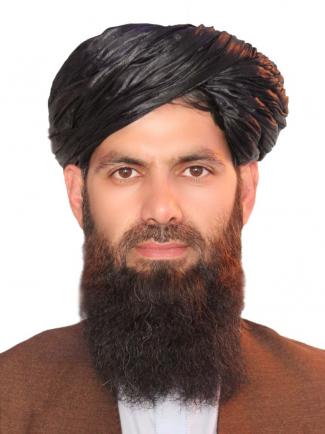
Al-Hajj Mawlawi Bismillah "Nafez"
Dean of the Faculty of Education
Strategic Objectives of the Faculty of Education
- To enhance both the quantitative and qualitative dimensions of education in alignment with national and international standards.
- To fully implement quality improvement and accreditation programs.
- To educate and develop young generations and students in accordance with Islamic values and global scientific standards.
- To design and establish academic programs that integrate Islamic principles with internationally recognized standards.
- To create a peaceful and healthy academic environment conducive to effective learning, research, and other scholarly and Islamic activities.
- To foster academic and professional coordination and collaboration with institutions and organizations that provide educational services.
Biography of the Dean of the Faculty of Education
Al-Haj Mawlawi Bismillah “Nafiz,” son of Mullah Abdul Ghafour, was born in the first month of Hamal in 1366 (Solar Hijri) in Kand village, Chora (Chahar Chinow) District, Uruzgan Province. He received his primary religious education in his native village. In mid-1385 (Solar Hijri), he completed his foundational religious studies at Al-Mansooriya Madrasa, located in Anarjoy village of the same district.
In late 1385 (Solar Hijri), Mawlawi Bismillah “Nafiz” migrated from his homeland to Pakistan. During his period of migration, in addition to pursuing advanced religious studies, he engaged in armed struggle against the American occupation alongside Shaheed Al-Haj Niaz Gul, Al-Haj Mullah Mohammad Lal Khalid, and Mawlawi Bari Gul Talib.
In 1437 (Hijri Qamari), in Lashkargah city of Helmand Province, he graduated from Al-Farooqiya Madrasa, receiving the turban of graduation (Dastar-e-Faraghat) upon completion of the Alimiyyah program. Following this, he returned to Anarjoy village in Chahar Chinow District, where he was engaged in teaching while also assuming leadership responsibilities of a jihadi group.
Professional Career in Government Administration
Following the establishment of the Islamic Emirate, Mawlawi Bismillah “Nafiz” was appointed as a Muhtasib (moral inspector) at the Department for the Promotion of Virtue, Prevention of Vice, and Hearing of Complaints in Daikundi Province. In addition, he served as Deputy of the Fiqh Council.
In his entrusted responsibilities, he carried out his duties with sincerity, dedication, knowledge, and practice, working tirelessly day and night to promote public welfare, encourage virtue, and prevent vice. In collaboration with religious scholars, he contributed to fostering peace, harmony, and social cohesion among the people.
On 28th of Sawr 1404 (Solar Hijri), based on the proposal of Daikundi University addressed to the Ministry of Higher Education, and upon the recommendation and approval of the Ministry of Higher Education as well as the Ministry for the Promotion of Virtue and Prevention of Vice, his appointment was forwarded to the Office of the Prime Minister. After final approval, he was officially appointed as the Dean of the Faculty of Education at Daikundi University, where he is currently serving with honesty and dedication.
|
|
Contact Number |
|
Educational Degree |
|
Last Name |
|
No.
|
||||||||
|
|
0776280722 |
Dean of Faculty |
|
No |
Nafiz |
|
1 |
||||||||
|
|
0775707535 |
Academic Manager |
Bachelor’s Degree |
No |
Hamdard |
Sultan |
2
|
||||||||
|
|
0765837009 |
Executive Manager |
Bachelor’s Degree |
No |
Rezaie |
Mohammadjan |
3 |
||||||||
|
|
0773065757 |
Laboratory Manager |
Bachelor’s Degree |
No |
Jafari |
Alikhan |
4 |
||||||||
|
|
0776736845 |
|
0 |
0 |
|
Mehrali |
5 |
||||||||
|
|
0765050848 |
Gardner |
0 |
0 |
|
Ahmad |
6 |
Profile of the Dean and the Administrative and Service Staff of the Faculty of Education
Program Profile: Mathematics Department
Introduction and Brief History of the Mathematics Department
The Department of Mathematics and Physics was established in 1393 (Solar Hijri) within the framework of the Faculty of Education. In its inaugural year (1393), the department admitted 60 students for the first time. The number of academic staff members initially stood at two and increased by one additional member in 1396. In the same year (1396), the department was formally divided into two separate departments: Mathematics and Physics. Furthermore, in 1397, another academic staff member was added, bringing the total number of academic staff to four, all holding Master’s degrees.
Over the course of seven graduating cohorts, the department has produced a total of 173 graduates, including 117 male and 56 female students.
Vision
The Mathematics Department is an active academic unit within the Faculty of Education, aiming to educate and train knowledgeable individuals and specialized professionals in the field of mathematics, and to provide quality higher education aligned with societal needs and labor market demands.
Mission
The Mathematics Department is committed to enhancing and advancing the professional knowledge of its students by providing opportunities for acquiring specialized mathematical knowledge in accordance with the needs of society.
Educational Objectives of the Mathematics Department
- To train qualified, committed, and professional teachers and faculty members for deployment in schools and universities.
- To familiarize students with modern mathematics.
- To highlight the importance of mathematics across all fields of natural and social sciences.
- To emphasize the role and status of mathematics in society and globally.
- To acknowledge the fundamental role of mathematics in the advancement of science and technology, recognizing that mastering any scientific or technical field today is not possible without the relevant mathematical foundation.
- To train mathematics specialists for scientific centers and schools under the Ministry of Education.
- To develop entrepreneurial, creative, and capable graduates aligned with societal needs through the application of the latest scientific developments in mathematics and the provision of improved educational facilities and resources.
- To strengthen and expand research and teaching capacities of academic staff in line with global developments.
- To conduct scientific research in mathematics and disseminate findings through national and international academic journals.
- To revise and improve curricula and educational programs in accordance with contemporary changes and societal needs.
- To provide services at both national and international levels.
Expected Learning Outcomes
- Acquisition of professional knowledge and skills in solving mathematical problems.
- Advancement from the current state toward an optimal condition in training educational leaders, researchers, and professional teachers equipped with pedagogical competencies responsive to educational needs.
- Demonstration of professional commitment and delivery of high-quality academic and research services in mathematics.
- Preparation of specialized, professional, and capable teachers, leaders, and researchers in mathematics, equipped with teaching, research, and pedagogical skills, professional integrity, and ethical conduct—without discrimination based on language, ethnicity, race, region, or gender.
Definition of Graduates of the Mathematics Program
The Mathematics Program of the Faculty of Education at Daikundi University has been established to train specialized and professional cadres for universities, teacher training colleges, institutes, and public and private schools.
Accordingly, a graduate of the Bachelor’s degree program in Mathematics is defined as a student who has successfully completed a minimum of 136 credit units over a four-year academic period (eight semesters), and who demonstrates the following competencies:
Knowledge:
Graduates should possess undergraduate-level mastery of mathematical theories, analysis, interpretation, and problem-solving, and be capable of providing appropriate academic responses.
Skills:
Graduates, in addition to acquiring professional knowledge and problem-solving skills in mathematics, should demonstrate competencies in research, analysis, pedagogical methods, familiarity with modern teaching approaches, basic computer applications, and proficiency in the English language.
Behavior:
Graduates should exhibit good moral character, professional and academic conduct, commitment to Islamic and human values, and a sense of patriotism, considering themselves responsible for contributing to national development.
Profiles of Mathematics Department Faculty Members
|
|
Contact Number |
|
Educational Degree |
|
Last Name |
|
No.
|
||||||||
|
|
0771803069 |
Lecturer |
|
Associate Professor |
Zirak |
Mohammad Ali |
1 |
||||||||
|
|
0777828559 |
Head of Department |
Master degree |
Assistant Professor |
Wahdat |
Zia |
2
|
||||||||
|
|
0774696598 |
Lecturer |
Master degree |
Associate Professor |
Poya |
Abbas |
3 |
||||||||
|
0771471438 |
Lecturer |
Bachelor’s Degree |
|
Zahidi |
Aliyawar |
4 |
Program Profile: Physics Department
Introduction and Brief History of the Physics Department
The Physics Department is an active academic unit within the Faculty of Education. It was initially established in 1393 (Solar Hijri) alongside the Mathematics Department within the Faculty of Education. In 1394, the department admitted 60 students through the national Kankor (university entrance) examination. In 1396, it was separated from the Mathematics Department and became an independent, degree-granting department.
Over the course of seven successful graduating cohorts, the department has produced a total of 165 graduates, including 110 male and 55 female students. The department currently has five academic staff members, of whom three hold Master’s degrees and two are currently pursuing their Master’s studies. At present, the department has 28 male students enrolled.
Vision
The Physics Department aspires to educate and graduate qualified, professional, and capable teachers, specialists, and leaders in the field of physics—equipped with teaching, research, and pedagogical competencies, professional commitment, and integrity—without discrimination based on language, ethnicity, race, region, or gender, and to deliver them to society.
Mission
The department offers nationally recognized academic programs, including updated curricula, with the aim of preparing qualified and specialized teachers and professionals in physics to meet the needs of universities, teacher training institutions, and schools across the country.
It also provides undergraduate (Bachelor’s level) education in physics for high school graduates, graduates of teacher training institutes (Darul-Moallemin), and in-service teachers from both public and private schools.
Educational Objectives of the Physics Department
- To focus on teaching and scientific research.
- To author and translate textbooks and supplementary instructional materials.
- To apply standard teaching methodologies and modern technologies.
- To establish cooperation with the Ministry and Directorate of Education.
- To enhance the professional knowledge and skills of academic staff.
- To train in standardized teaching methodologies.
- To strive for quality improvement in teaching.
- To establish a well-equipped library for faculty members and students.
- To create a specialized physics learning and training center for students and faculty.
Expected Learning Outcomes
- Acquisition of professional knowledge and skills in solving physics problems.
- Advancement from the current state to an optimal condition in training leaders, educational researchers, and professional teachers equipped with pedagogical skills responsive to the needs of the education system.
- Demonstration of professional commitment and provision of high-quality academic and research services in physics.
- Promotion of scientific, specialized, and professional development of physics teachers and instructors, with emphasis on strengthening teaching skills, research capacity, and pedagogical competencies, along with professional integrity and ethical conduct—without discrimination based on language, ethnicity, race, region, or gender.
Definition of Graduates of the Physics Program
The Physics Program of the Faculty of Education at Daikundi University is designed to train specialized and professional personnel for universities, teacher training colleges, institutes, and public and private schools.
Accordingly, a graduate of the Bachelor’s degree program in Physics is defined as a student who has successfully completed a minimum of 162 credit units over a four-year academic period (eight semesters), and who meets societal expectations in terms of knowledge, skills, and behavior.
Graduates should demonstrate undergraduate-level mastery of physics concepts, including analysis, interpretation, and problem-solving, and be capable of providing appropriate academic responses.
Profiles of the Academic Staff of the Physics Department
|
|
Contact Number |
|
Educational Degree |
|
Last Name |
|
No.
|
||||||||
|
|
0771203522 |
Lecturer |
Master degree |
Associate Professor |
Sirst |
Sayed Anwar |
1 |
||||||||
|
0775010019 |
Lecturer |
Master degree |
Assistant Professor |
Anosh |
Allayar |
2
|
|||||||||
|
|
0764750531 |
Head of Department |
Master degree |
Assistant Professor (Candidate) |
Haidari |
Reza |
3 |
||||||||
|
|
0779107595 |
Lecturer |
Bachular degree |
Assistant Professor (Candidate) |
Royesh |
Reza |
4 |
||||||||
|
|
0778846496 |
Lecturer |
Bachular degree |
Assistant Professor (Candidate) |
Sharifi |
Murtaza |
5 |
Program Profile: Chemistry Department
Introduction and Brief History of the Chemistry Department
The Chemistry Department is an active academic unit within the Faculty of Education at Daikundi University. It was established with the aim of training scientific cadres, specialists, and professional, skilled teachers in the field of chemistry, based on a standardized curriculum approved by the Ministry of Higher Education and delivered by qualified academic staff.
The department was initially established in 1393 (Solar Hijri) under the title of Chemistry and Biology, alongside the establishment of the Faculty of Education at Daikundi University. In 1396, it became an independent department under the name Chemistry, separating from the combined Chemistry and Biology program.
Currently, the department has four academic staff members, including one with a Master’s degree, two with Bachelor’s degrees, and one currently pursuing a Master’s degree. By the year 1404 (Solar Hijri), the department has successfully graduated seven cohorts, producing a total of 158 graduates, including 100 male and 58 female students. At present, the department has 22 male students enrolled.
Vision
The Chemistry Department is an active unit within the Faculty of Education, aiming to train knowledgeable individuals, specialized and professional teachers, and capable and active leaders in the field of chemistry. It emphasizes teaching, research, and pedagogical competencies, alongside professional commitment and integrity, without discrimination based on language, ethnicity, race, region, or gender, and seeks to provide scientific, specialized, and professional education aligned with the needs of society and the labor market.
Mission
The mission of the Chemistry Department is to educate students with a comprehensive understanding of the structure and behavior of matter, enabling them to solve scientific and applied problems. Through credible theoretical and practical instruction, the program fosters a spirit of research, scientific rigor, and responsible application of chemical knowledge, preparing graduates to play effective roles in research, industry, and environmental sectors.
Educational Objectives of the Chemistry Department
- To provide a conducive and supportive environment for effective teaching, research, and quality learning in various areas of chemistry.
- To train committed and professional teachers and specialists for deployment in schools and universities.
- To teach and familiarize students with the importance of chemistry and its relationship with other natural and scientific disciplines.
- To introduce modern and advanced curricula.
- To prepare textbooks and introduce reliable national and international academic references.
- To assign academic advisors to guide students in each class.
- To establish a well-equipped and accessible library (both physical and digital).
Expected Outcomes of the Chemistry Department
The department aspires to become a dynamic, well-organized academic unit aligned with national and international standards. In line with its objectives, it aims to meet societal needs by producing professional, specialized, committed, and ethically grounded teachers and experts who uphold high human and national values.
The department also seeks to graduate students free from ethnic, linguistic, regional, or sectarian biases, enabling them to compete academically and professionally at both national and international levels with graduates of chemistry programs abroad. In doing so, the department strives to fulfill its responsibilities toward God, society, and the nation with integrity.
Definition of Graduates of the Chemistry Program
The Chemistry Program of the Faculty of Education at Daikundi University is designed to train specialized, professional personnel and capable leaders for educational institutions, including universities, teacher training institutes, and public and private schools. It aims to prepare qualified teachers and specialists in chemistry equipped with teaching, research, and pedagogical skills, professional commitment, and integrity—without discrimination based on language, ethnicity, race, region, or gender.
Accordingly, a graduate of the Bachelor’s degree program in Chemistry is defined as a student who has completed at least 136 credit units over a four-year academic period (eight semesters), and who demonstrates the following competencies:
A. Knowledge:
Graduates should possess the ability to compete with peers at regional and international levels, and demonstrate competence in research, analysis, and evaluation of chemical substances. They should have a solid understanding of core areas such as general chemistry, inorganic chemistry, and physical chemistry, and comprehend their applications in industry, commerce, science, education, agriculture, medicine, and pharmacy.
B. Skills:
Graduates should have an adequate command of the English language and the technical language of chemistry. They should be capable of preparing scientific papers, be familiar with software such as ChemDraw and Microsoft Office, and possess sufficient computer skills to address relevant professional challenges.
C. Behavior:
Graduates should demonstrate strong ethical character, respect for Islamic and national values, professional and academic conduct, religious and patriotic commitment, and respect for legal and human rights. They should uphold justice in all affairs, remain committed to their duties and country, and act with a strong sense of accountability and integrity.
Needs Assessment (National and Labor Market Needs)
Chemistry is one of the fundamental branches of scientific knowledge, with significant applications in industrial production—particularly in mineral processing and other applied fields. There is a strong demand for qualified and professional chemistry teachers in schools. Additionally, chemistry plays a vital role in agriculture and industry, including the production of chemical fertilizers, pharmaceuticals, and synthetic polymers.
Chemistry Laboratory
The Chemistry Department laboratory consists of one room and is open to students from 8:00 AM to 4:00 PM. Students and faculty conduct practical and experimental work based on the available materials and equipment.
Career Prospects of Graduates
Chemistry graduates can contribute significantly in various scientific and industrial sectors. Their expertise is particularly important in industrial production, mineral processing, and other applied domains. There is a high demand for professional chemistry teachers in schools. Graduates may also work as specialists in agriculture and industry, contributing to the production of fertilizers, medicines, and synthetic materials.
Key areas demonstrating the importance and employment scope of this field include:
- Addressing the shortage of academic staff in universities.
- Training chemistry teachers for public and private schools.
- Teaching and leading academic and laboratory activities in chemistry.
- Collaborating in various chemistry-related fields in universities and other national research institutions.
Profiles of Academic Staff of the Chemistry Department
|
|
Contact Number |
|
Educational Degree |
|
Last Name |
|
No.
|
||||||||
|
|
0778214499 |
Head of Department |
Master degree |
Associate Professor |
Ramish |
Sayed Mohammad |
1 |
||||||||
|
Ghulammohammadhamdard20@gmail.com
|
0773601107 |
Lecturer |
Bachelor’s Degree |
Assistant Professor (Candidate) |
Hamdard |
Gholam Mohammad |
2
|
||||||||
|
0774758601 |
Lecturer |
Bachelor’s Degree |
Assistant Professor (Candidate) |
Wasiq |
Jumakhan |
3 |
|||||||||
|
0799724610 |
Lecturer |
Master degree |
Assistant Professor |
Yazdani |
Nazar Ali |
4 |
Program Profile: Biology Department
Introduction and Brief History of the Biology Department
The Chemistry and Biology Department was established in 1393 (Solar Hijri) within the Faculty of Education. In 1396, it was divided into two independent departments: Chemistry and Biology.
Currently, the Biology Department has six academic staff members, including two with Master’s degrees, two pursuing Master’s studies abroad, and two holding Bachelor’s degrees. The department has successfully graduated seven cohorts, with a total of 174 graduates, including 100 male and 74 female students.
According to recent statistics compiled by the department, approximately 80% of its graduates are employed in government institutions and international organizations. At present, the department has 56 male students enrolled.
Vision
The Biology Department is an active academic unit within the Faculty of Education, aiming to educate knowledgeable individuals and specialized professionals in the field of natural sciences, and to provide high-quality higher education aligned with societal needs and labor market demands.
Mission
The Biology Department is committed to enhancing and developing the professional knowledge and modern skills of students, and to facilitating the acquisition of specialized knowledge in related scientific fields in accordance with societal needs.
Educational Objectives
The primary objectives of the department include the application of standardized teaching methods and modern technologies to train committed and professional teachers and specialists, as well as to enhance the scientific knowledge and professional competencies of students.
Expected Outcomes
The Biology Department strives to become a dynamic and well-organized academic unit aligned with national and international standards. In line with its objectives, it aims to meet societal needs by producing professional, specialized, and ethically committed teachers and experts who uphold high human and national values.
The department aspires to graduate students free from ethnic, linguistic, regional, or sectarian biases, enabling them to compete academically and professionally at the national level with graduates of Biology programs from other universities. In doing so, the department seeks to fulfill its responsibilities toward God, society, and the nation with integrity.
Definition of Graduates of the Biology Program
The Biology Department has been established to train specialized and professional personnel for educational institutions, including universities, teacher training colleges, institutes, and public and private schools. It aims to prepare skilled and competent individuals capable of addressing societal needs in educational sectors.
Accordingly, a graduate of the Bachelor’s degree program in Biology is defined as a student who has successfully completed a minimum of 146 credit units over a four-year academic period (eight semesters), and who demonstrates undergraduate-level mastery across biological subjects.
Profiles of Biology Department Faculty Members
|
|
Contact Number |
|
Educational Degree |
|
Last Name |
|
No.
|
||||||||
|
7769851183 |
Head of Department |
Bachelor’s Degree |
Assistant Professor (Candidate) |
Hashimi |
Sayed Mohammad |
1 |
|||||||||
|
0772982800 |
Lecturer |
Master degree |
Assistant Professor |
Arvin |
Assadulla |
2
|
|||||||||
|
0771030209 |
Lecturer |
Master degree |
Assistant Professor |
Mohammadi |
Mohammad Hamid |
3 |
|||||||||
|
775195375 |
Lecturer |
Master degree |
Assistant Professor |
Mohammadi |
Hamid |
4 |
|||||||||
|
|
766962631 |
Lecturer |
Bachelor’s Degree |
Assistant Professor (Candidate) |
Rezaiy |
Murtaza |
5 |
Program Profile: Department of English Language and Literature
Introduction and Brief History of the Department of English Language and Literature
The Department of English Language and Literature is an active academic unit within the Faculty of Education. It was established in 1404 (Solar Hijri) as part of the Faculty of Education.
Currently, the department has four academic staff members, all holding Bachelor’s degrees, and is set to begin student admissions through the national Kankor examination starting in 1405.
Vision
The Department of English Language and Literature aims to educate and graduate qualified, professional, and capable teachers, specialists, and leaders in the field, equipped with teaching, research, and pedagogical competencies, along with professional commitment and integrity. The department upholds principles of equality and inclusivity, without discrimination based on language, ethnicity, race, region, or gender, and strives to deliver high-quality academic and professional education to society.
Mission
The department offers nationally recognized academic programs, including updated curricula, with the objective of preparing qualified and specialized teachers in English language and literature to meet the needs of universities, teacher training institutions, and schools across the country.
It provides undergraduate (Bachelor’s level) education in English Language and Literature for high school graduates, graduates of teacher training institutes, and in-service teachers from both public and private schools.
Educational Objectives
- To focus on teaching and scientific research.
- To develop and translate textbooks and supplementary instructional materials.
- To apply standardized teaching methodologies and modern technologies.
- To establish collaboration with the Ministry and Directorate of Education.
- To enhance the professional knowledge and skills of academic staff.
- To train in effective and standardized teaching methodologies.
- To promote continuous improvement and quality teaching.
- To establish a well-equipped library for faculty members and students of the department.
- To create a specialized learning center for students and faculty.
Expected Outcomes
- Acquisition of professional knowledge and skills in literary principles and English studies.
- Advancement toward an optimal state in preparing leaders, educational researchers, and professional teachers equipped with pedagogical competencies responsive to the needs of the education system.
- Demonstration of professional commitment and delivery of high-quality academic and research services in the field of English.
- Enhancement of academic, professional, and specialized capacities of faculty members and teachers in English Language and Literature, with emphasis on strengthening teaching skills, research capabilities, and pedagogical competencies, alongside professional integrity and ethical conduct—without discrimination based on language, ethnicity, race, region, or gender.
Profiles of Academic Staff of the English Department
|
|
Contact Number |
|
Educational Degree |
|
Last Name |
|
No.
|
||||||||
|
0778994740 |
Lecturer |
Bachelor’s Degree |
Assistant Professor (Candidate) |
Ghafory |
Salahuddin |
1 |
|||||||||
|
|
0767369980 |
Lecturer |
Bachelor’s Degree |
Assistant Professor (Candidate) |
Mirzaye |
Ali |
2
|
||||||||
|
0771485821 |
Lecturer |
Bachelor’s Degree |
Assistant Professor (Candidate) |
Farahmand |
Hussain Reza |
3 |
|||||||||
|
|
0765724073 |
Lecturer |
Bachelor’s Degree |
Assistant Professor (Candidate) |
|
Mohammad Azim |
4 |